
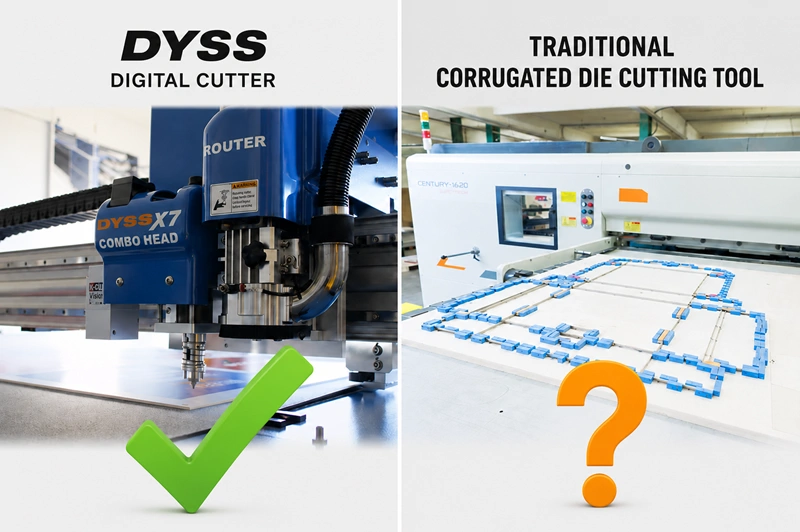
 The packaging and display industries are constantly under pressure to deliver faster turnaround times, greater customisation, and improved cost efficiency. As product/project lifecycles become shorter and demand for short-run production increases, many manufacturers are evaluating whether traditional die cutting remains the best option or whether digital flatbed cutting offers a more flexible alternative.
Understanding the strengths and limitations of each approach can help businesses make informed decisions and maximise profitability.
What is traditional die cutting?
Die cutting uses a custom-made steel rule die to cut specific shapes from materials such as corrugated board, cartonboard, foam, plastics, and display materials.
For long production runs, die cutting can be extremely efficient. Once the die has been manufactured and set up, large quantities of identical products can be produced quickly and consistently.
However, traditional die cutting comes with several challenges
- Upfront tooling costs for every new design
- Longer lead times while dies are manufactured
- Storage requirements for physical dies
- Reduced flexibility for design changes
- Higher costs for short-run production and prototyping
These limitations can become significant when customers require frequent design revisions or lower production volumes.
What is a digital flatbed cutter?
A digital flatbed cutter uses computer-controlled cutting tools to process materials directly from digital design files without the need for physical tooling.
This enables manufacturers to move from design to production almost immediately, reducing setup times and eliminating die manufacturing costs.
Digital cutting technology is particularly valuable for
- Packaging prototypes
- Short-run production
- Point-of-sale displays
- Signage applications
- Custom packaging
- Corrugated packaging production
Because there are no physical dies to produce, design revisions can be implemented instantly, allowing businesses to respond quickly to customer requirements.
Flatbed cutter vs die cutting - Key differences
Setup Costs
Traditional die cutting requires a new die for each design, creating additional costs before production can begin.
Digital flatbed cutters eliminate tooling costs entirely, making them highly cost-effective for prototypes, short runs, and customised work.
Speed to Market
Producing a die can add days or even weeks to a project timeline.
Digital cutting systems can begin production as soon as the design file is approved, significantly accelerating delivery times.
Flexibility
Design changes often require modifications or replacement of existing dies.
Digital cutting allows operators to update files instantly, making it ideal for environments where designs frequently evolve.
Production volumes
For very high-volume, repeat production, traditional die cutting can still offer advantages.
For short-to-medium runs, customised production, and rapid prototyping, digital cutting often delivers greater efficiency and lower overall costs.
Material versatility
Modern digital cutters can process a wide variety of materials using different tool configurations.
This flexibility allows manufacturers to diversify their product offerings without investing in multiple dedicated systems.
Why DYSS digital cutters stand out
When investing in digital cutting technology, reliability and versatility are essential.
A DYSS digital cutting system has established a reputation as a proven, robust, and reliable solution for packaging, display, signage, and industrial applications. Designed to cope with a vast array of media, DYSS machines can process materials ranging from corrugated board and cartonboard to foam, plastics, composites, and display substrates.
Key benefits include
- Exceptional cutting accuracy
- High production reliability
- Flexible tooling options
- Fast job changeovers
- Reduced operational costs
- Support for multiple material types
For businesses seeking to expand beyond traditional die cutting limitations, DYSS provides a powerful platform capable of supporting both prototyping and production requirements.
Maximising efficiency with intelligent CAD design
The effectiveness of any cutting workflow begins long before the cutting table itself. Intelligent structural design software plays a critical role in reducing waste, improving productivity, and accelerating production.
KASEMAKE has become a trusted solution within the packaging industry by enabling designers to create highly accurate structural packaging designs while optimising material usage and production efficiency.
By integrating intelligent CAD design into the workflow, businesses can
- Reduce material wastage through optimised layouts
- Improve nesting efficiency
- Increase cutting speeds
- Minimise production errors
- Accelerate design revisions
- Streamline the path from concept to finished product
When combined with digital cutting technology, KASEMAKE enables manufacturers to achieve faster turnaround times while making more efficient use of valuable materials.
A winning combination for modern packaging production
For businesses looking to improve agility, reduce waste, and respond more quickly to customer demands, the combination of KASEMAKE CAD software and DYSS digital cutting technology offers a compelling solution.
KASEMAKE provides intelligent structural design and optimisation capabilities, while DYSS delivers reliable, high-performance cutting across a broad range of media. Together, they create a streamlined workflow that reduces costs, improves efficiency, and enables rapid production without the constraints of traditional tooling.
Conclusion
Traditional die cutting remains an effective solution for certain high-volume production environments. However, as demand for shorter runs, faster delivery, and greater customisation continues to grow, digital flatbed cutting is becoming the preferred choice for many manufacturers.
With the proven reliability and flexibility of DYSS digital cutters and the intelligent design optimisation capabilities of KASEMAKE, businesses can reduce waste, improve productivity, and gain a competitive advantage in today's fast-moving packaging and display markets.

