
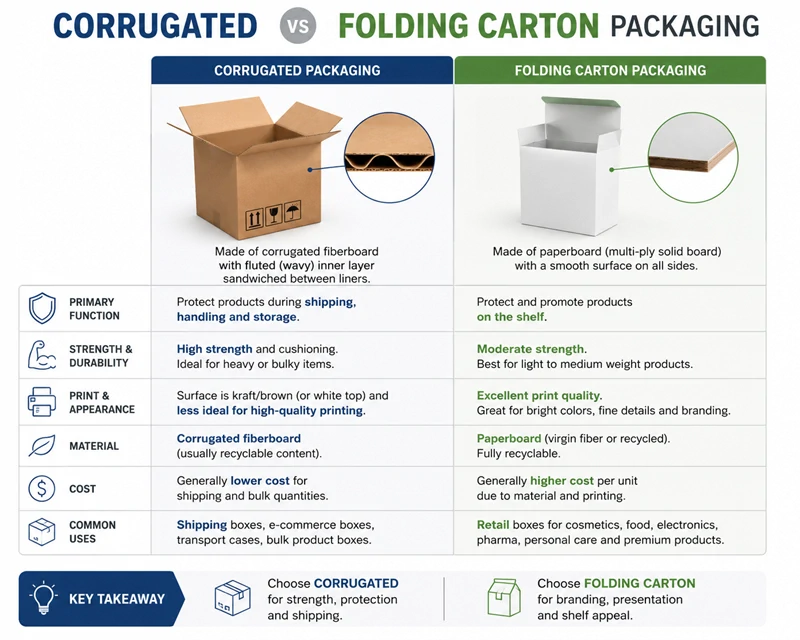
 When developing packaging for retail or transit applications, one of the first decisions designers and manufacturers face is choosing between corrugated packaging and folding carton packaging. While both materials are paper-based and widely used across the packaging industry, they serve very different purposes and require different structural approaches during the design process.
Understanding the differences between these packaging formats helps brands optimise protection, presentation, logistics, sustainability, and production efficiency.
What is corrugated packaging?
Corrugated packaging is designed primarily for strength and protection. It is made from multiple layers of paperboard, typically consisting of
- An outer liner
- A fluted medium (there can be multiple fluted layers on double/triple wall boards)
- An inner liner
The fluted layer creates rigidity and cushioning, making corrugated ideal for
- Shipping cartons
- Transit cases
- Shelf Ready Packaging (SRP)
- Pallet-ready outer cases
- Heavy-duty industrial packaging
- E-commerce packaging
Key Benefits of Corrugated Packaging
- Protective cushioning from airspace between inner/outer liners
- Strong stacking performance
- High durability during transport
- Suitable for heavier products
- Good printability for retail-ready transit packaging
- Recyclable and sustainable
Corrugated packaging is commonly seen in warehouse distribution, supermarket replenishment systems, and logistics operations where product protection is critical.
What is folding carton packaging?
Folding cartons are typically manufactured from solid board materials such as boxboard, SBS, FBB, or GC board grades. Unlike corrugated, folding cartons do not contain fluting and are generally thinner and smoother.
They are widely used for
- Retail product cartons
- Cosmetic packaging
- Pharmaceutical cartons
- Food sleeves and cartons
- Consumer goods packaging
- Premium branded packaging
Key Benefits of Folding Cartons
- High-quality print finish
- Excellent shelf appeal
- Lightweight construction
- Efficient die cutting and folding
- Cost-effective for retail presentation
- Ideal for smaller consumer products
Folding cartons focus more on branding and consumer presentation than heavy-duty protection.
The structural design differences
Designing corrugated packaging differs significantly from designing folding cartons because the material behaviour is completely different. Because of these differences, packaging designers require CAD systems capable of handling both material types accurately.
How KASEMAKE supports both corrugated and folding carton design.
KASEMAKE is widely used throughout the packaging industry because it supports both corrugated and folding carton workflows within a single CAD environment.
This flexibility allows designers to move seamlessly between
- Transit packaging
- Shelf Ready Packaging (SRP)
- Retail cartons
- Point of sale displays
- Protective inserts
- Parametric packaging designs
Built-in scaleable parametric drawings
One of the major advantages of KASEMAKE is its library of scaleable parametric drawings. Rather than creating every design from scratch, KASEMAKE includes extensive libraries of intelligent parametric packaging designs. These are pre-engineered packaging styles that can be resized instantly by entering product dimensions and material specifications. This significantly speeds up packaging development while maintaining manufacturing accuracy.
Examples Include
- Corrugated Styles
- Regular Slotted Cases (RSC)
- Shelf Ready Packaging (SRP)
- Transit cases
- Die-cut mailers
- Heavy-duty export cartons
- Pallet display trays
- Folding Carton Styles
- Reverse tuck end cartons
- Straight line cartons
- Crash lock cartons
- Sleeve packs
- Pharmaceutical cartons
- Retail presentation packs
Because these drawings are parametric, designers can rapidly generate production-ready concepts while maintaining structural standards and manufacturing rules.
Why parametric packaging design matters
In modern packaging development, speed and consistency are critical. Parametric design enables
- Faster concept generation
- Reduced design errors
- Consistent manufacturing outputs
- Accurate material allowances
- Rapid customer amendments
- Improved costing workflows
For businesses handling both corrugated and cartonboard projects, this capability dramatically reduces development time.
Supporting the full packaging workflow
KASEMAKE is not limited to structural CAD alone. The software also supports
- 3D visualisation
- Sample making
- Powerful database
- Integration with MIS software
- Design approval presentations
This makes it suitable for packaging converters, brand owners, design agencies, and manufacturers working across multiple packaging sectors.
Choosing the right packaging material
Selecting between corrugated and folding carton packaging depends on several factors
Choose Corrugated When
- Product protection is critical
- Shipping durability is required
- Products are heavy
- Packaging must stack on pallets
- SRP functionality is needed
Choose Folding Carton When
- Appearance is the priority
- Premium branding is important
- Products are lightweight
- High-quality graphics are required
- Retail presentation drives sales
In many retail environments, both materials work together, folding cartons are packed inside corrugated outers for transport and distribution.
Final Thoughts
Corrugated and folding carton packaging each play essential roles within modern packaging supply chains. While corrugated focuses on protection and logistics performance, folding cartons are designed to maximise retail appeal and consumer experience. For packaging designers working across both disciplines, tools like KASEMAKE provide the flexibility to design efficiently using intelligent parametric packaging libraries tailored to each material type.
By combining structural accuracy, rapid resizing, and production-ready outputs, KASEMAKE helps packaging teams reduce development time while improving design consistency across a wide range of packaging applications.
